
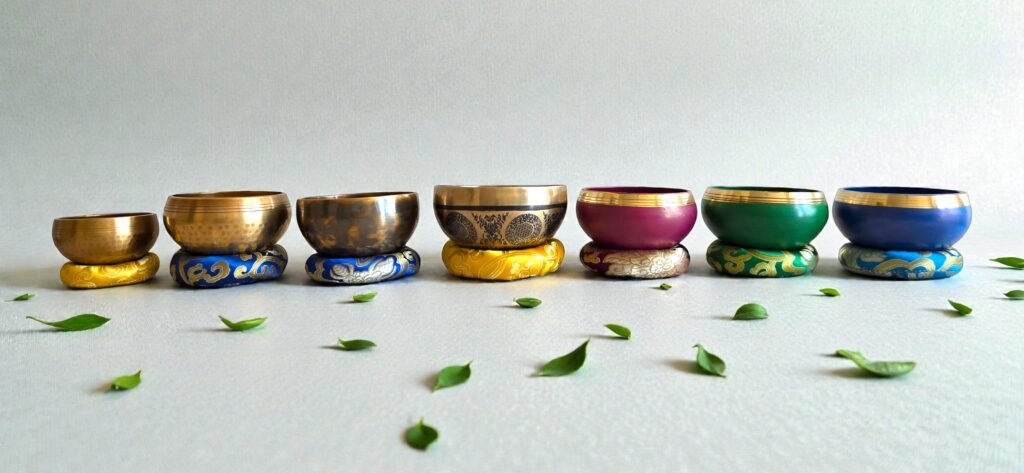
Strike a singing bowl and the sound seems ancient. But where do singing bowls actually come from? The honest answer is more interesting than the legends: it runs through the metal workshops of Nepal’s Kathmandu Valley, the mountain trade routes to Tibet, and a 1970s record that gave the bowls their modern name.
QUICK ANSWERS
Singing bowls grew out of the Himalayan tradition of hand-hammered metal bowls, a craft centered for centuries in Nepal’s Kathmandu Valley. Historians have found little written evidence that bowls were “sung” by rimming in old Tibet; the name “singing bowl” and their use for sound meditation became widespread in the West from the 1970s.
Key Takeaway
- Nepal’s Newar artisans have worked metal for well over a thousand years, and Patan is still the heart of that craft.
- Hand-hammered metal bowls were everyday and ritual vessels across the Himalaya.
- The name “singing bowl” is modern; a 1971–72 album, Tibetan Bells, was the first recording to feature them.
- Most bowls sold as “Tibetan” are, and long have been, made in Nepal.
Where do singing bowls come from?
Singing bowls come from the Himalayan world: Nepal, Tibet, Bhutan, and the mountain regions of northern India. The skills needed to make them, shaping bronze by hand with hammers and fire, are part of one of Asia’s great metalworking traditions.
That tradition has a home address. Metal crafts in Nepal go back to at least the sixth century, and the city of Patan (Lalitpur), next to Kathmandu, is widely considered the origin of Nepal’s metal cottage industry. Newar families there passed techniques down through generations rather than in written manuals. For centuries, Newar artisans also worked for Tibetan patrons, which is one reason Himalayan metalwork carries both Nepali and Tibetan influences.
A timeline of the singing bowl
- From c. 5th–6th century CE:
Metal crafts flourish in the Kathmandu Valley during the Licchavi period, the earliest well-documented era of Nepali metalwork. - 13th–18th century:
Under the Malla kings, Newar metalcraft in Patan, Kathmandu, and Bhaktapur reaches its classical peak, with royal and Tibetan patronage. - Mid-1700s:
Metal craftsmen migrate from Patan to towns such as Tansen, Chainpur and Bhojpur, spreading the craft across Nepal. - 1950s–1960s:
Nepal opens its borders; travelers begin bringing Himalayan metal bowls home from Kathmandu. - 1971–1972:
Henry Wolff and Nancy Hennings record Tibetan Bells, the first album built around Himalayan bells and singing bowls. The name sticks. - 1990s–today:
Books, yoga studios, and sound baths make the singing bowl a worldwide meditation tool, still largely handmade in Nepal.
Were singing bowls used in ancient Tibet?
This is where the popular story and the historical record part ways. Many websites say Tibetan monks have played singing bowls for 2,000 years or more. Researchers who have looked closely, including the Tibetan historian Tsering Shakya, have found no credible written evidence that Tibetans played resonating bowls the way sound practitioners do today.
What is well documented is that hand-hammered bowls were made and used across the Himalaya as practical and ritual vessels. A bowl that holds food or an offering will also ring when struck. Over time, and especially once Western musicians and seekers arrived, that natural ring became the point.
MYTH
Tibetan monks played singing bowls for thousands of years.
WHAT THE EVIDENCE SHOWS
Himalayan metal bowls are old, but written records of “singing” them by rimming are recent. The term itself appears in the 1970s.
MYTH
Every traditional bowl contains seven sacred metals, including gold and silver.
WHAT THE EVIDENCE SHOWS
Reported analyses of antique bowls find mostly bronze (copper and tin), sometimes with traces of iron. The seven-metal story is folklore.
How did singing bowls get their name?
In 1969, two American musicians, Henry Wolff and Nancy Hennings, traveled to India and Nepal and studied with teachers of the Kagyu branch of Tibetan Buddhism. In 1971, they recorded Tibetan Bells in London using their collection of bells, cymbals, and bowls. It was the first recording of its kind and helped shape what became new-age music.
Bowl makers in Nepal often say the same thing: the bowls were part of daily life long before anyone called them “singing bowls.” The English name came with the Western visitors.
Why are most singing bowls made in Nepal?
Even bowls labeled “Tibetan” are usually made in Nepal, and that is no accident. Patan and the wider Kathmandu Valley kept the skills, families, and workshops alive. Today, artisans there still heat bronze, hammer it into shape by hand, and tune each bowl by ear.
| Hand-hammered bowl | Machine-made bowl |
|---|---|
| Shaped by hand with hundreds of hammer strokes | Spun or cast on a lathe |
| Visible hammer marks, each bowl unique | Smooth, uniform surface |
| Layered tone with long overtones | Simpler, shorter tone |
| Made in small workshops, often family-run | Made in factories in large batches |
The singing bowl’s real history isn’t a myth. It’s a living craft, passed hand to hand in Nepal’s workshops.
How are singing bowls used today?
Today, people use singing bowls for meditation, yoga, relaxation, sound baths, and simple daily rituals, such as one tone to start the morning. You don’t need an ancient legend to enjoy that. A well-made bowl gives you a clear, slowly fading sound that is easy to focus on, and every hand-hammered bowl carries the skill of the person who made it.
Pulukisi and the Nepali craft tradition
Pulukisi is a Nepali family brand. Our name comes from the white elephant of Kathmandu’s Indra Jatra festival, and our bowls are hand-hammered in Nepal. When you hold one, you hold a piece of a craft tradition that has shaped Himalayan life for centuries, and that still lives in the hands of Nepali artisans today.
Frequently Asked Questions
Hand-hammered metal bowls have a long history in the Himalaya, and Nepal’s metal crafts date back to at least the sixth century. The practice of playing them as “singing bowls” for meditation is much more recent, and the name became common in the 1970s.
Both cultures share the Himalayan metalworking tradition, but most singing bowls, including many labeled “Tibetan,” are made in Nepal, especially in and around the Kathmandu Valley.
Traditional singing bowls are made mostly of bronze, an alloy of copper and tin. Studies of antique bowls have not found the gold, silver or mercury described in the “seven metals” legend.
Travelers brought bowls home from Nepal from the 1960s, and the 1971–72 album Tibetan Bells by Henry Wolff and Nancy Hennings was the first recording to feature them. Books and the yoga and meditation boom of the 1990s did the rest.
No. Singing bowls are widely used by people of all backgrounds for meditation and relaxation. Learning their real history and buying from Himalayan artisans is a respectful way to enjoy them.
Hear a hand-hammered bowl for yourself
Pulukisi singing bowls are hand-hammered in Nepal and come ready to play, with mallet and cushion.
Keep Reading
References & further reading
- Tricycle: The Buddhist Review. “Tibetan Singing Bowls.” Link
- Savage Minds (anthropology blog). “Tripping on Good Vibrations: Cultural Commodification and Tibetan Singing Bowls,” 2015. Link
- Alsop, Ian. “Metal Image-casting in Nepal.” Asianart.com. Link
- Global InCH. “Metal craft in Patan, Nepal.” Link
- Shakya, L. “The History of Newar City and Development of Newar Art and Crafts.” IRCI, 2025. Link
- “Tibetan Bells” (1971 album by Henry Wolff and Nancy Hennings). Wikipedia. Link
- Jansen, Eva Rudy. Singing Bowls: A Practical Handbook of Instruction and Use. Binkey Kok, 1990.
- Perry, Frank. The Complete Book of Singing Bowls: Himalayan Sound Revelations. Adarsh Books, 2015.